A Complete Guide to Massage Therapy for Mental and Physical Well-Being
Table of Contents
- The Science Behind Massage Therapy
- Therapeutic Benefits for Mental and Emotional Health
- Therapeutic Benefits for Physical Performance and Recovery
- Types of Massage Therapy
- Massage Therapy for Specific Groups
- Who Should Avoid Massage Therapy?
- Conclusion
- FAQs
| Summary Understand the science behind how massage therapy affects your nervous system, stress hormones (cortisol), and feel-good chemicals (serotonin and dopamine).The profound therapeutic benefits for mental and emotional health include managing stress, anxiety, and improving sleep quality.Massage enhances physical performance and recovery by improving tissue health, circulation, and mitigating pain and delayed onset muscle soreness (DOMS).A guide to the most common types of massage therapy, such as Swedish, Deep Tissue, Sports Massage, and Lymphatic Drainage.Specific recommendations for how different groups—including athletes, office workers, seniors, and pregnant women—can benefit from tailored massage techniques.A critical list of conditions and situations where you should avoid or seek medical clearance before receiving massage therapy. |
For centuries, humans have practiced massage as a complementary and alternative medicine that manipulates muscles, tendons, fascia, connective tissues, and other soft tissues. Massage has a long history of 5000 years.
Today, massage therapy is a vital component of integrative medicine, supporting a holistic approach to health.
The Science Behind Massage Therapy
Massage creates measurable changes in your body, affecting your stress levels, mood, immune system, and even muscle recovery.
Calming the Nervous System
Your body slips into “fight-or-flight mode” when you are stressed, keeping you tense and alert. Massage activates thousands of tiny receptors which send messages to your brain telling it to relax and guide your body back into its “rest-and-digest” state.
Lowering Stress Hormones
Cortisol, also known as the stress hormone, is produced in response to stressful situations. Increased secretion of cortisol prepares the body for a “fight or flight” response. High cortisol levels over prolonged periods can lead to fatigue, irritability, anxiety, and a weakened immune system. Massage can significantly reduce cortisol levels.
Boosting Feel-Good Chemicals
Massage increases levels of neurotransmitters, especially serotonin (by 28%) and dopamine (by 31%), which are responsible for helping you feel happy, balanced, and energized.
- Serotonin is associated with mood and feelings of calmness.
- Dopamine is linked to motivation and pleasure.
Supporting the Immune System and Reducing Inflammation
Massage reduces your body’s inflammatory responses. It also eases discomfort, calms irritated tissues, and helps prevent chronic pain from taking hold.
| Natural Killer cells protect your body against viruses and abnormal cells. |
Studies show that massage can increase the activity and number of Natural Killer (NK) cells.
Improving Tissue Health, Flexibility, and Circulation
Massage deforms muscle fibres and fascia, sending signals to relax tension, lengthen fibres and reduce stiffness. Increased fluid exchange within the fascia breaks down adhesions, softening tight, stiff areas.
Massage stimulates capillaries, delivering more oxygen to cells, more nutrients to damaged tissues and faster removal of lactic acid, inflammatory chemicals and other waste products.
Improved circulation helps remove prostaglandins, cytokines, and metabolic waste that have accumulated.
Massage also activates muscle repair cells (satellite cells) and fibroblasts, cells that form connective tissue.
Therapeutic Benefits for Mental and Emotional Health
Managing Stress, Anxiety, and Depression
Dropped cortisol levels and increased serotonin and dopamine levels shift your body into a more peaceful state. A six-week study reveals that the human body responds quickly to regular Swedish massage, with a sharp decline in anxiety scores.
The study finds that massage helps the nervous system ‘settle’, which lifts mood and lowers depression.
Enhanced Sleep
An overactive sympathetic nervous system maintains a state of heightened alertness, which can lead to sleep disturbances. Massage therapy helps address insomnia by reducing stress hormones, promoting relaxation, and increasing melatonin production.
A relaxation massage before bed helps you fall asleep faster and stay asleep longer, resulting in a more restful night’s sleep. All you need are simple and soothing techniques—slow strokes and light pressure before bedtime.
Lowered Perceived Stress
Massage activates the parasympathetic nervous system, reducing the body’s stress response. A reduced stress response allows your brain to stop producing excess cortisol, which in turn reduces feelings of tension, nervousness, worry, and emotional overwhelm.
| The Parasympathetic Nervous System is the part of the autonomic nervous system that controls “rest and digest” functions, slowing the heart rate, lowering blood pressure, and increasing digestive activity to conserve energy during relaxation. |
Enhanced Relaxation Response
Massage reduces blood pressure, slows breathing, and enhances heart rate variability, shifting your body from ‘fight-or-flight’ to ‘rest-and-digest.’
You are mentally quiet and emotionally calm.
Improved Emotional Well-Being
Massage stimulates the release of feel-good chemicals that are responsible for maintaining mood stability, boosting motivation, and fostering emotional resilience.
- With lower cortisol and improved serotonin regulation, the brain becomes better at modulating emotional responses, resulting in a steadier and more balanced mood over time.
- Prolonged muscle tightness continuously signals “stress” to the brain. Massage releases tension and breaks this feedback loop, which improves your emotional well-being.
Therapeutic Benefits for Physical Performance and Recovery
Musculoskeletal Health and Pain Mitigation
Massage therapy releases tension and muscle knots, which improves flexibility and range of motion. It also stimulates the release of endorphins, peptides produced in the brain that act as natural painkillers and mood elevators. Studies show that a 30-minute session of connective tissue massage can increase beta-endorphins by 16%.
Athletic Performance and Injury Recovery
Increased circulation enhances oxygen and nutrient delivery to muscles, while also helps flush out waste products. This accelerates recovery after intense exercise and injury. Massage can significantly reduce delayed onset muscle soreness (DOMS) up to 72 hours after exercise.
| Delayed Onset Muscle Soreness (DOMS) is the muscle pain and stiffness that occurs after strenuous exercise. |
A review of 99 studies finds that massage reduces muscle damage, biomarkers and inflammation.
Continuous deep tissue massage, particularly focusing on joint mobility and muscle function in the lumbar region, knee, and shoulder, improves athletic performance.
Specialized Treatment for Chronic Pain Syndromes
Fibromyalgia (FM)
A meta‑analysis of randomized controlled trials involving 404 patients with Fibromyalgia (FM) shows that massage therapy for 5 weeks or longer improves pain and depression.
Lymphatic Drainage Massage
It is a specialized technique that stimulates lymphatic flow to reduce tissue swelling, especially after surgery or in cases of lymphedema. Lymphatic Drainage Massage guides excess fluid toward functional lymph nodes, which helps clear toxins.
Types of Massage Therapy
| Type | Goal | Technique | Benefits |
| Swedish Massage | Relaxation and stress relief | Long, gliding strokes, kneading, friction, tapping | Reduces stressImproves circulationRelaxes muscles |
| Deep Tissue Massage | Relieve chronic muscle tension | Slow, deep strokes targeting muscle layers and fascia | Eases chronic painImproves mobilityReduces stiffness |
| Sports Massage | Enhance athletic performance | Combination of stretching, deep tissue, and trigger point work | Prevents injurySpeeds recoveryImproves performance |
| Trigger Point Therapy | Release localized pain | Focused pressure on tight “knots” | Reduces painReleases tensionImproves range of motion |
| Myofascial Release | Improve mobility | Gentle sustained pressure on fascia | Relieves stiffnessImproves flexibilityReduces pain |
| Thai Massage | Improve flexibility & energy flow | Assisted stretching, rhythmic compressions | Enhances flexibilityRelieves tensionRestores energy |
| Shiatsu | Restore energy balance | Finger, thumb, and palm pressure along meridians | Relieves tensionRestores energyImproves circulation |
| Hot Stone Massage | Muscle relaxation | Heated stones applied with or without massage | Relaxes musclesImproves circulationReduces stress |
| Aromatherapy Massage | Relaxation & emotional wellness | Massage with essential oils | Reduces stressImproves moodPromotes relaxation |
| Prenatal Massage | Reduce pregnancy discomfort | Gentle strokes tailored for pregnant women | Eases achesReduces swellingRelieves stress |
| Lymphatic Drainage Massage | Reduce swelling & support immunity | Gentle, rhythmic movements along lymphatic pathways | Reduces edemaSupports immune functionDetoxifies |
| Reflexology | Improve organ function & relaxation | Pressure on reflex points (feet, hands) | Improves circulationPromotes relaxationSupports organ function |
Massage Therapy for Specific Groups
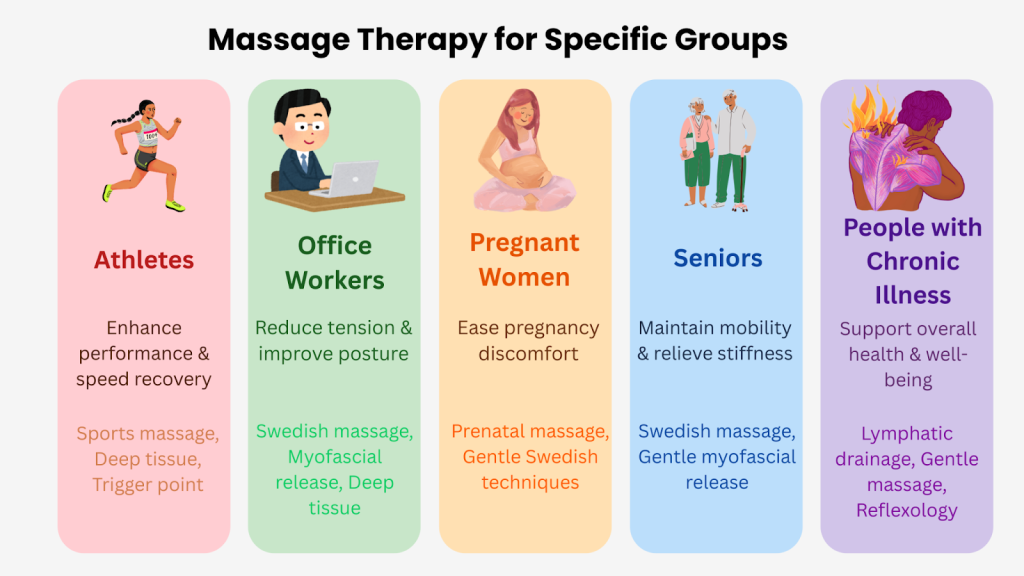
Some people aim to enhance their athletic performance, while others seek to improve their emotional well-being. Different massage therapies offer different physical and mental health benefits.
| Group | Massage Goal | Recommended Techniques | Key Benefits |
| Athletes | Enhance performance & speed recovery | Sports massageDeep tissueTrigger point | Speeds up recoveryReduces muscle sorenessPrevents injuries |
| Office Workers | Reduce tension & improve posture | Swedish massageMyofascial releaseDeep tissue | Relieves neck/back tensionReduces stressImproves flexibility |
| Pregnant Women | Ease pregnancy discomfort | Prenatal massageGentle Swedish techniques | Reduces swellingAlleviates achesPromotes relaxation |
| Seniors | Maintain mobility & relieve stiffness | Swedish massageGentle myofascial release | Improves circulationEnhances flexibilityReduces chronic pain |
| People with Chronic Illness | Support overall health & well-being | Lymphatic drainageGentle massageReflexology | Reduces painImproves circulationBoosts immunityReduces stress |
Who Should Avoid Massage Therapy?
Seek medical clearance before massage therapy if:
- You have medical conditions such as Blood clots (Deep Vein Thrombosis), severe heart conditions, open wounds or acute inflammation or fever.
- You take blood-thinning medications, painkillers, or anti-inflammatory medications.
- You have high-risk complications.
- You have recent fractures or sprains.
- Your surgical site is still healing.
- You have advanced osteoporosis, cancer, or severe autoimmune diseases.
- You are allergic to massage oils, lotions, or creams.
Conclusion
Massage therapy is incredibly beneficial for your physical and mental health, with all health benefits scientifically proven. A right therapist can tailor techniques to your individual needs, ensuring maximum benefits for your body, mind, and overall well-being. So, massage can be a powerful tool in your regular self-care routine.
Take the next step in caring for your mind and body. Book a personalized massage session with Ultimate Health Clinic today and feel the difference that expert, tailored therapy can make. Schedule your appointment now and prioritize your well-being!
FAQs
How much clothing should I keep on?
Most sessions require you to partially or fully undress. The therapist uses draping (towels or sheets) to cover areas not being worked on.
Will I ever be exposed during the massage?
No, only the area being massaged is uncovered. The therapist always ensures your privacy and dignity at all times.
What should I do if it hurts during the massage?
Massage is not supposed to be painful. If you experience pain, then speak to the therapist immediately to adjust pressure and change technique.
How often should I get a massage?
It depends on your goals and health condition. A massage session every 2-4 weeks is beneficial for your overall health. Athletes or those with chronic pain may benefit from weekly sessions.
What happens if I fall asleep during the massage?
It’s perfectly normal to fall asleep as your body is fully relaxed. The therapist will continue working while you rest.
Is massage painful?
It should not be overwhelmingly painful. Some deep tissue or trigger point techniques may cause mild discomfort as tight muscles release tension. However, your therapist monitors your response and adjusts pressure and technique accordingly.